
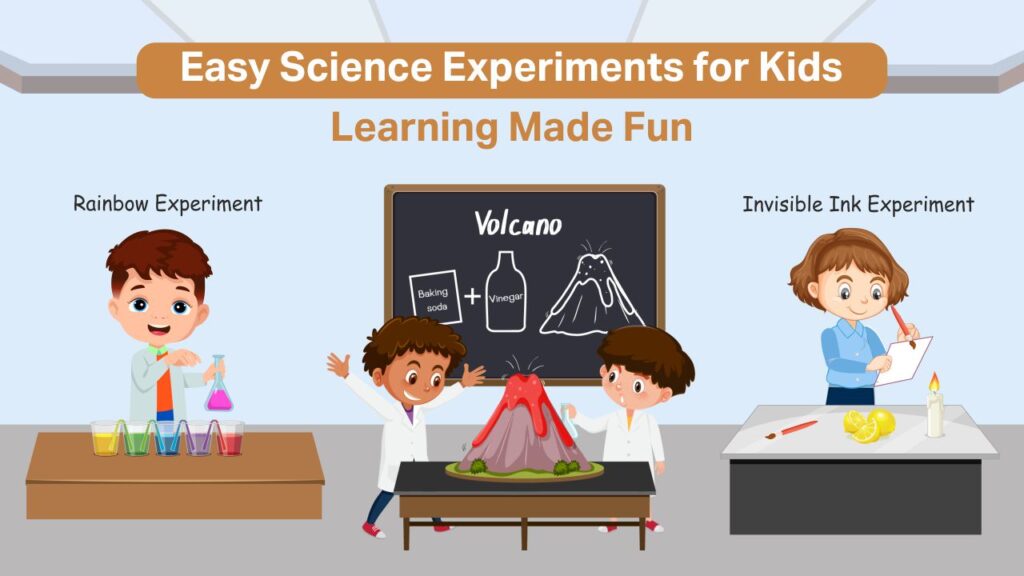
Practical learning plays a crucial role in helping children understand science beyond textbooks. When students actively observe, test, and explore concepts, learning becomes more meaningful and long-lasting. Easy science experiments can make complex ideas simple, exciting, and relatable. They spark curiosity and encourage creative thinking from an early age. By engaging in hands-on activities, children develop a love for discovery and problem-solving. Schools play an important role in this process by integrating experiments into classroom learning. In this blog, easy science experiments to do at home will be covered. The importance of these experiments for children will also be discussed here.
Easy Science Experiments
Below are some easy science experiments to do at home:
Volcano
A favourite among science lovers that illustrates a traditional chemical process.
Things Needed
Small bottle or container (like an empty soda bottle), vinegar, baking soda, dish soap (for more foam), red food colouring, and a tray or basin (to catch the overflow).
Way To Do It
Put the bottle into the tray. Fill the bottle with a few drops of food colouring, a dab of dish soap, and a few spoonfuls of baking soda. Watch the volcano erupt after adding vinegar!
Science Behind It
Vinegar (acetic acid) is an acid, whereas baking soda (sodium bicarbonate) is a base. Carbon dioxide gas is produced when they combine and go through an acid-base reaction. The frothy liquid is forced out of the bottle by the gas’s quick expansion.
Rainbow
Children can make a vibrant rainbow with sugar, water, and food colouring in this experiment.
Things Needed
Sugar (4 tablespoons), Water (4 cups, divided), Food Colouring (4 different colours), and one glass.
Way to Do It
In each of the four cups of water, dissolve varying amounts of sugar. Add one tablespoon to the first cup, two tablespoons to the second, and so on. Apply a different food colouring to each cup of water. Using a spoon to prevent mixing, gradually pour each coloured water into the glass. Due to the disparity in densities, children will produce a rainbow effect in which the layers stay apart.
Science Behind It
This experiment works on the principle of density. When sugar dissolves in water, it increases the liquid’s density. Solutions with more sugar become heavier than those with less sugar. By carefully layering the sugar solutions from highest to lowest concentration, the denser liquids stay at the bottom while the lighter ones float on top. This difference in density prevents the layers from mixing, creating a clear and colourful rainbow effect.
Invisible Ink
Another fun experiment is making invisible ink with lemon juice.
Things Needed
Lemon juice, a cotton swab or paintbrush, a candle or light bulb (a light source), and paper.
Way to Do It
Write a message on a piece of paper using a cotton swab or a paintbrush dipped in lemon juice. To make the message invisible, let the juice totally dry. Heat the paper gently over a candle or lightbulb to reveal the message. The writing will become visible when the heat oxidises and turns the lemon juice brown.
Science Behind It
This has happened because the acid in the juice reacts with oxygen. Through this, children learn about chemical reactions and oxidation.
Water Walking
Watch the capillary action as the colours blend together without stirring.
Things Needed
Water, food colouring (primary colours: red, yellow, and blue), paper towels, and multiple clear glasses.
Way to do it
Put the glasses in a circle. Pour water into each glass in turn. Fill each glass with water and add various food colours. Paper towels should be rolled into strips and placed between the glasses that are filled with water and those that are empty. Watch the coloured water “walk” up the paper towels and into the empty glasses over the course of several hours, finally blending the colours.
Science Behind It
This illustrates capillary action, which is a liquid’s capacity to move against gravity in confined places. The cellulose fibres that make up the paper towels create microscopic gaps. The water is drawn up the towel by the attraction of water molecules to the cellulose (adhesion) and to one another (cohesion). The colours blend together as water flows from one glass to another.
Floating Egg
Investigate density and buoyancy using a basic egg.
Things Needed
A fresh egg, two glasses of water, salt, and a spoon.
Way to do it
Gently put the egg into a glass filled with normal tap water. It ought to sink. Children need a good amount, perhaps 1/4 to 1/2 cup, so add several spoonfuls of salt to the water in the second glass and mix until dissolved. Put another egg into the saltwater gently. It ought to float!
Science Behind It
If an object’s density is lower than that of the fluid it is submerged in, it will float. The density of the water is increased when salt is added. The egg sinks because it is denser than ordinary water. However, it floats because it is less thick than really salty water!
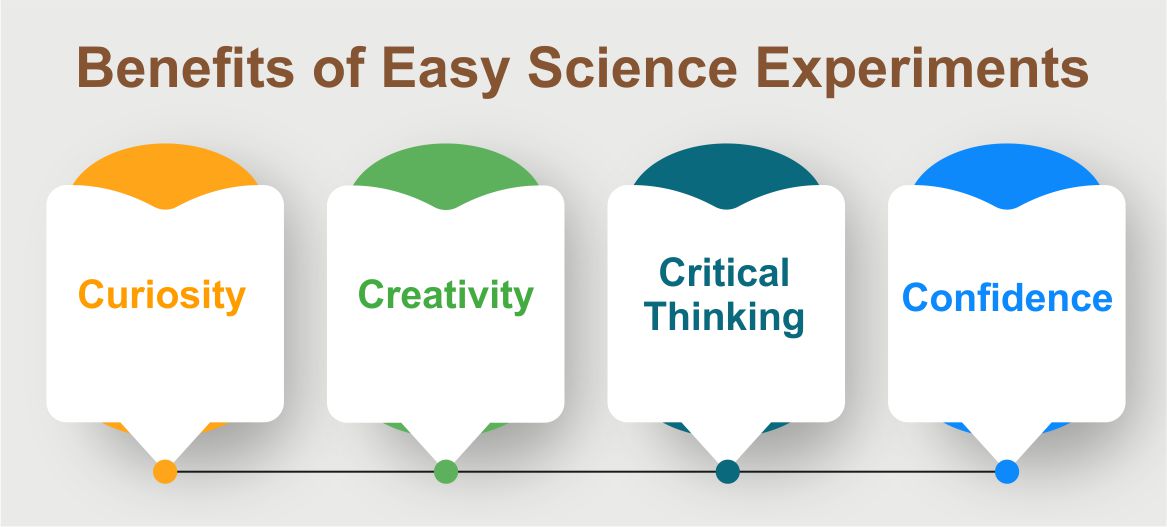
Benefits of Easy Science Experiments for Children
Below are the benefits of easy science experiments to do at home for children:
- Develops scientific thinking
- Improves creativity and curiosity
- Strengthens confidence and communication skills
- Encourages questioning and exploration
Simple Safety Tips for These Experiments
Before conducting these easy science experiments, it is important to follow the safety tips below:
- Conducting experiments under adult supervision
- Doing experiments in a safe place away from other parts of homes, especially the kitchen
- Use of safe materials
How Schools in Gurgaon Encourage Science Learning
Below are the ways the best schools in Gurgaon, including K.R. Mangalam World School (KRMWS), encourage science learning:
- Emphasis on experiential and inquiry-based learning
- Science clubs, fairs, and project-based activities
- Collaboration between teachers, students, and parents
Conclusion
To sum up this blog article, children’s curiosity can be stimulated, and basic scientific concepts can be better understood by doing easy science experiments. By choosing top schools in Gurgaon like KRMWS, children can receive an education that values experiential learning and nurtures a lifelong love for science.
Choose KRMWS if someone wants a place where a scientific temperament is encouraged.
FAQs
Q1. What are easy science experiments for children?
Easy science experiments are simple, safe activities that use everyday materials to explain basic scientific concepts in a fun and engaging way.
Q2. Can these science experiments be done at home?
Yes, many easy science experiments to do at home require minimal materials and can be safely performed with adult supervision.
Q3. Why are hands-on science experiments important for kids?
Hands-on experiments improve understanding, boost curiosity, and help children retain concepts better than textbook learning alone.
Q4. How do schools in Gurgaon support practical science learning?
Many schools in Gurgaon focus on activity-based learning, regular lab sessions, science projects, and exhibitions to encourage experimentation.
Q5. Why should parents choose top schools in Gurgaon like KRMWS?
Top schools in Gurgaon, such as KRMWS, promote experiential learning by integrating practical experiments into everyday teaching, helping students develop scientific thinking and creativity.